
Photo → priced inventory
The photo is the interface.
Sorting Table turns phone photos of card trays into structured, priced inventory with a decision attached to every card — list it, lot it, bulk it, grade it, or hold it for a human. It was built for one job: liquidating about 25,000 Pokémon cards without inventorying 25,000 Pokémon cards.
A private single-operator system: the processing workbench stays local, the new wireless Scan Stream feeds it straight from a phone, and where it actually stands is written below, plainly.

-
Act I
Photograph
Tray photos from a phone are the whole intake — no grid to declare, no scanner bed, no cable.
-
Act II
Recognize & price
Geometry finds the cards, a vision model and the local catalog name them, print-run and condition rules price them.
-
Act III
Decide & route
Every card gets one of five destinations and a reason, and the physical pile moves to match.
The number that shapes everything
Everything above the bulk floor lives in 1–3% of the cards.
So the pipeline’s job is not to inventory 25,000 cards. It is to find the few hundred that matter and inventory those precisely. Photographing every modern common would spend hours proving that nearly all of them belong in bulk.
And the rule that drives the hard parts
For vintage, the card number does not determine the value.
| 1st Edition | $15,000+ |
|---|---|
| Shadowless | $2,000–3,000 |
| Unlimited | $300–500 |
A 30–50× spread on an identical card number. So no vintage card is auto-priced from its number alone, and anything at or above the $5 listing floor with an uncertain variant goes to a person.
How it works
Five stages, and each one can be stopped in the middle.
Every stage reads the previous stage’s durable output and writes its own, so a crash, a rate limit, or a reworded prompt never re-spends the vision budget. A retry resumes at the first unfinished stage.
-
01
Photograph
Act IDrop tray photos. You do not declare a grid — intake reads the layout off the picture and reports what it found. Shoot 3×3, 4×5, or a ragged eleven.
-
02
Detect
Act IIClassical computer vision proposes the card rectangles. No model, no network, no cost. It is an assistant, not an oracle, and the app is explicit about that: a photo only spends a paid read unattended when the geometry says nothing is missing.
-
03
Identify
Act IIEach framed card goes to a vision model as its own image, then matches against the local catalog. What the camera saw is stored separately from what the app concluded, so the matcher can improve and the whole pile can be re-resolved without re-photographing anything.
-
04
Price
Act IICatalog floors, print-run keys, and condition multipliers. The high-resolution close-up that settles a vintage variant is not bought until the card can repay it — below the listing floor the call is never made, and the item is stamped with the reason.
-
05
Route
Act IIIEvery card gets a destination and a reason. Then the physical cards move to match, one batch at a time, and a batch cannot be marked routed while any decision on it is incomplete.
Act III — the decision
Five destinations, drawn by what the card can actually net.
eBay takes roughly 13.25% plus $0.30, and a card in a toploader ships for about $1.20. A $5 sale nets around $2.84. A $2 sale nets around $0.23. Individually listing a $2 card is volunteer work, so the thresholds are drawn where the money stops paying for the handling.
-

Bulk
under $1
Sold by the pound. Never individually listed.
-

Lot
$1–5
Grouped by set and rarity into one listing.
-

List
$5–20
Individual listing. Above $20, a human confirms first.
-

Grade
$200+
A grading candidate, where a slab may beat a raw sale.
-

Hold
uncertain
Vintage at or above $5 whose print run is not settled. Overrides its price tier.
Just landed
The phone is now the table camera.
The newest capability of the private pilot is the wireless Scan Stream: the phone sits over the tray and captures flow straight into intake — no cable, no camera roll, no copying files across.
It is deliberately hard to fool. A card’s region turns green only when its photo holds a durable, server-verified receipt — not when the shutter fires, not when an upload starts. Kill the browser, lose the Wi-Fi, walk away: captures survive refresh and network loss, and everything verified flows into the same local recognition pipeline as any other photo.
Part of the private pilot — hosted for one phone, not a public surface.
- captured held on the phone; survives a refresh
- uploading retries through network loss
- receipt verified durable on the server — only now does the region turn green

What it keeps
The original photo is the durable thing.
Every machine conclusion traces back to a source photo, a processing run, and an observation. Every human edit — condition, price, identity, disposition, a duplicate linked or unlinked — writes a row to a decisions ledger in the same transaction as the edit itself. That ledger is what makes undo survive a refresh, a crash, and tomorrow evening.
It also refuses to guess where guessing would be expensive. Two rows sharing a card ID are a question, not a finding: you own real multiples, and collapsing on identity alone would quietly delete cards you have while the ledger still reconciled. Nothing merges without a person, and both answers — “same card, shot twice” and “two cards I own” — are recorded and stick.
Fact sheet
Real numbers, measured on the machine this runs on.
Verified 15 August 2026 against the working install — the test suite and the local spend ledger, not a marketing estimate.
- ~25,000
- Cards in the pile being liquidated — about 100 lbs of vintage and modern.
- 977
- Core Python tests, all passing, plus dedicated live-scan server and Android suites.
- 16 / 145
- Batches photographed and cards carried through the pipeline so far.
- $2.64
- Total vision spend to date, against a hard local ceiling of $25.00. Processing stops before the call that would cross it.
- $0.0207
- Measured cost of reading one tray photo, settled from the provider’s own usage numbers rather than estimated.
- $0.0077
- Measured cost of one vintage close-up — the pass that separates a $300 Charizard from a $15,000 one.
- 20,444
- Catalog cards loaded locally, carrying identity. Prices are fetched only for cards that actually resolve.
- 64.2%
- Card-detector recall on the hand-boxed validation set, in-sample. Published because it is low, and because knowing when it is lost is what makes it usable.
Where this actually stands
One operator, one phone, one pile.
Sorting Table is a real working tool doing real work, and it is not a product you can sign up for. Its private wireless Scan Stream is hosted for one phone; the processing workbench and inventory database remain local while the canonical hosted lifecycle is built.
Built and running
The full photo-to-routing pipeline, the operator workbench, the evidence viewer and traceback, the spend ledger, duplicate adjudication, the sale-import and calibration loop, and the export manifests, plus a private wireless Android capture loop with durable evidence receipts and an explicit intake kill switch.
Specified, not built
Canonical hosted inventory: authenticated Postgres with row-level security, a durable processing queue and worker, dashboard CRUD and routing, then reconciled marketplace draft and publish lifecycles.
Not claimed, on purpose
An AI grade, an authentication verdict, or one true market price. Condition stays human because vision cannot reliably read edge wear or centering, and condition swings value two to five times.
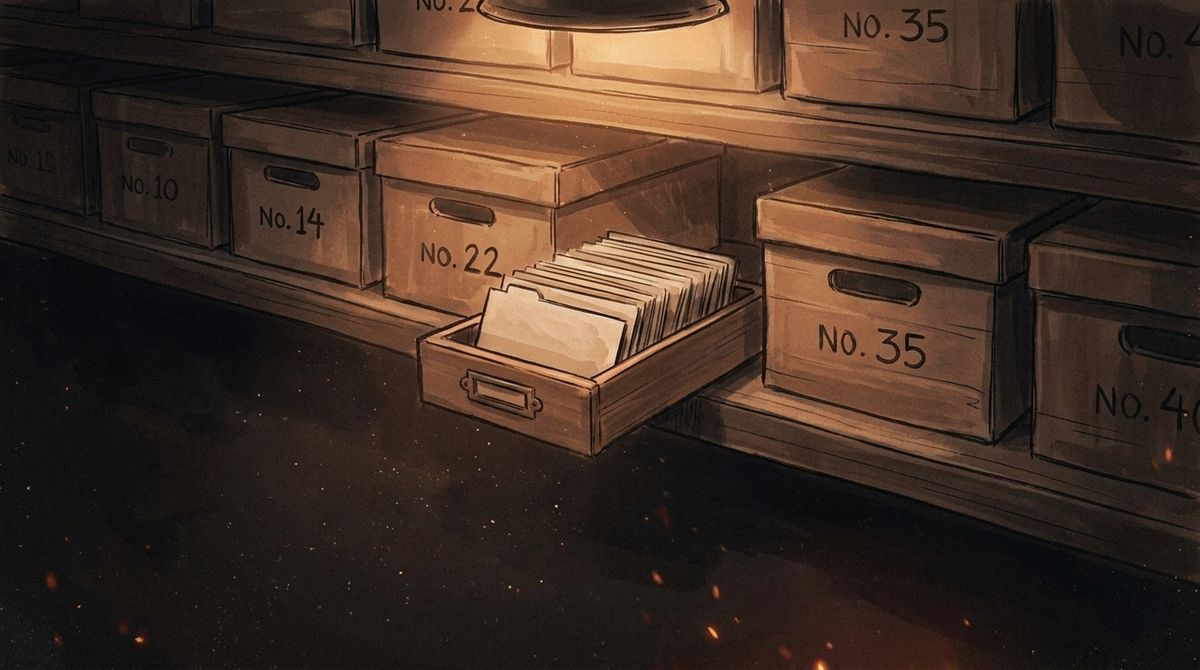
Know every card. Keep the proof. Pick what happens next.
A scanner identifies a catalog product. A tracker stores a quantity. A grader produces a slab. A marketplace owns an order. The person is left to remember which physical copy it was, what the original photo showed, what got corrected, and what finally happened to it. That continuity is the part being built here.
The waitlist
When the hosted version is real enough to hand to a stranger, the people on this list hear first. One email, no drip campaign, and the address is stored hashed-keyed in a private store — it is not shared, sold, or mailed for anything else.